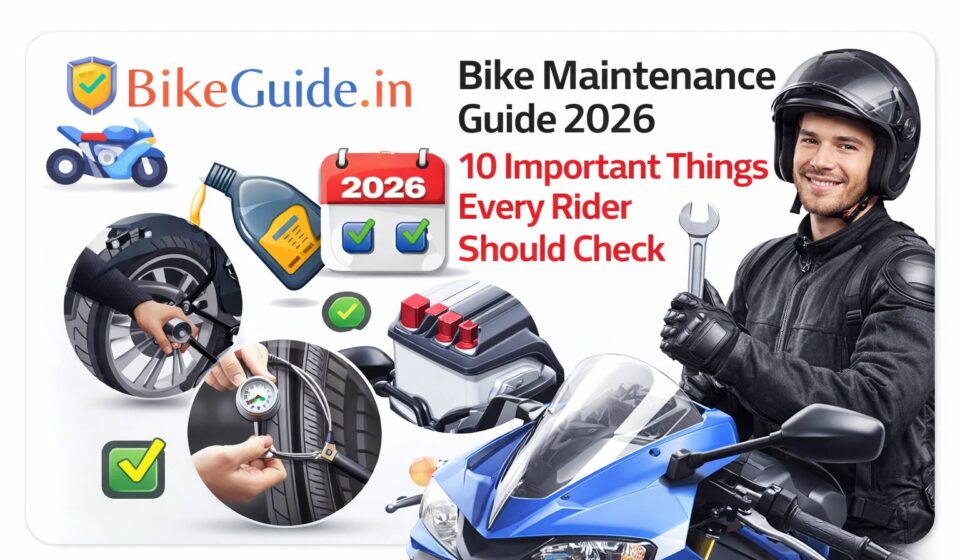
Bike Maintenance Guide 2026 – 10 Important Things Every Rider Should Check

Table Of Content
- 1. Engine Oil Level & Quality (Check Every 500–1,000 km)
- 2. Tyre Pressure & Condition (Check Weekly / Every Ride)
- 3. Chain & Sprocket Condition (Check Every 500–800 km)
- 4. Brake Pads & Fluid Level (Check Every 1,000 km / Monthly)
- 5. Air Filter Cleaning (Check Every 1,000–2,000 km)
- 6. Battery & Electrolyte Level (Check Monthly)
- 7. Lights, Horn & Electricals (Check Weekly)
- 8. Coolant Level (Liquid-Cooled Bikes – Monthly)
- 9. Spark Plug Condition (Every 4,000–6,000 km)
- 10. Overall Visual & Audible Inspection (Before Every Long Ride)
- Quick Monthly Maintenance Checklist (10–15 min)
- Final Thoughts
- Disclaimer
Regular bike maintenance in 2026 is even more critical in India due to rising fuel prices, worsening road conditions in many cities, extreme summer heat (45°C+), monsoon damage, and higher daily mileage for commuters & delivery riders. Skipping checks can lead to breakdowns, accidents, or expensive repairs (₹5,000–30,000+).
Here are the 10 most important things every rider should check regularly — whether you’re riding a Splendor, Shine, Raider, Pulsar, Apache, or any 100–400cc bike.
1. Engine Oil Level & Quality (Check Every 500–1,000 km)
- Why critical: Heat thins oil → poor lubrication → engine seizure (especially in summer).
- What to do: Check level with dipstick (bike on centre stand, engine cold). Use recommended grade (mostly 10W-30 or 20W-40 semi-synthetic). Change every 3,000–4,000 km or 3–4 months.
- Tip 2026: BS-VI engines have tighter tolerances — never use cheap/mineral oil in summer.
2. Tyre Pressure & Condition (Check Weekly / Every Ride)
- Why critical: Under-inflated tyres = more heat, punctures, poor grip, higher fuel use, & blowouts at speed.
- Recommended pressure (cold tyres): Front 28–32 PSI | Rear 32–36 PSI (check your bike manual — varies by load).
- What to look for: Tread depth >1.6 mm, no cuts/cracks, no bulges. Replace every 25,000–35,000 km.
- Tip 2026: Tubeless tyres now standard — carry puncture kit + portable compressor for highways.
3. Chain & Sprocket Condition (Check Every 500–800 km)
- Why critical: Loose/dry chain = power loss, noise, accelerated wear, or chain snap at speed.
- What to do: Clean with kerosene + brush, apply dry chain lube (PTFE/wax-based – doesn’t attract dust). Adjust slack (20–30 mm). Replace chain+sprocket set every 20,000–30,000 km.
- Tip 2026: O-ring/X-ring chains last longer – use them if your bike allows.
4. Brake Pads & Fluid Level (Check Every 1,000 km / Monthly)
- Why critical: Worn pads or low fluid = longer stopping distance → accidents in traffic or highways.
- What to do: Check pad thickness (>2 mm left), fluid level in reservoir (between MIN-MAX). Top up DOT 3/4 brake fluid. Replace pads every 8,000–15,000 km.
- Tip 2026: Many new models now have CBS or dual-channel ABS – get them bled every 2 years.
5. Air Filter Cleaning (Check Every 1,000–2,000 km)
- Why critical: Dusty Indian roads clog filter fast → less power, higher fuel consumption, engine damage.
- What to do: Tap paper filter gently or wash foam filter (mild soap + dry completely). Replace paper filter every 10,000–15,000 km.
- Tip 2026: Pre-filter mesh/outer foam cover now common – clean it first.
6. Battery & Electrolyte Level (Check Monthly)
- Why critical: Heat evaporates electrolyte → weak starting, especially in summer mornings.
- What to do: Check water level (top up with distilled water if low). Clean terminals. Charge if bike not used >2 weeks.
- Tip 2026: Most bikes now have maintenance-free (MF) batteries – still check terminals & voltage (~12.6V+ resting).
7. Lights, Horn & Electricals (Check Weekly)
- Why critical: Faulty headlight/horn/indicators = fines + accidents at night.
- What to do: Test high/low beam, indicators, brake light, horn. Replace burnt bulbs (mostly LED now – last 5–10 years).
- Tip 2026: Many new models have LED + automatic headlight on – check wiring & fuses if issues.
8. Coolant Level (Liquid-Cooled Bikes – Monthly)
- Why critical: Overheating in traffic/summer → warped head, costly repair.
- What to do: Check reservoir (engine cold) – between MIN-MAX. Use 50:50 coolant + distilled water. Flush every 2 years.
- Applies to: Apache RTR 160 4V, Pulsar NS200, Dominar, Himalayan 450, RTX 300, etc.
9. Spark Plug Condition (Every 4,000–6,000 km)
- Why critical: Fouled/worn plug = poor pickup, higher fuel use, misfiring.
- What to do: Remove, check gap (0.7–0.8 mm), clean or replace (iridium plugs last 20,000–30,000 km).
10. Overall Visual & Audible Inspection (Before Every Long Ride)
- Check: Loose bolts/nuts (especially engine mounts, footpegs, handlebar), chain slack, tyre damage, brake cable stretch, exhaust leaks, unusual noises/vibrations.
- Quick 5-minute ritual: Start engine → listen for odd sounds → rev gently → check lights/horn → look under bike for oil leaks.
Quick Monthly Maintenance Checklist (10–15 min)
- Tyre pressure (cold)
- Engine oil level
- Chain lubrication & slack
- Brake fluid & pad wear
- Battery electrolyte/terminals
- Lights, horn, indicators
- Air filter dust check
- Coolant level (if applicable)
- Loose parts/nuts
- Test ride 1–2 km – feel for unusual vibrations/noises
Final Thoughts
Spend ₹2,000–4,000/year on timely maintenance → save ₹10,000–50,000 in major repairs & stay safe. In 2026, most new bikes are BS-VI (tighter tolerances) — stick to recommended oil grades & service intervals strictly.
Do these 10 checks religiously — your bike will thank you with reliable, economical, and safe rides every day.
Ride safe — helmet always on, regular breaks on long rides!
Disclaimer
This guide is for informational purposes only, based on general manufacturer recommendations and real rider experiences as of March 2026. Always refer to your specific bike’s owner manual for exact intervals & specifications. We are not affiliated with any brand. Consult authorised service centres for complex issues. Actual maintenance needs depend on riding conditions, bike model, and usage. Ride responsibly & follow traffic rules.